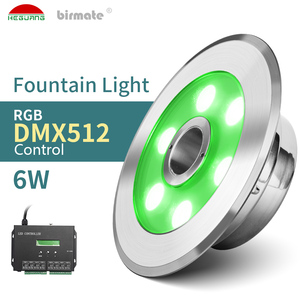
Engineered for high-frequency dynamic water shows, municipal plazas, and luxury resort features. Each unit incorporates marine-grade stainless steel housings, high-lumen CREE/Bridgelux LED arrays, and precision DMX control.
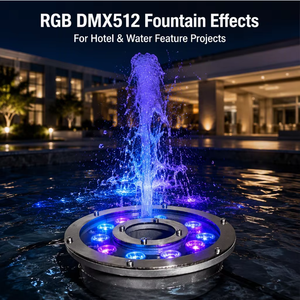
Architectural illumination and commercial aquatic design have undergone a fundamental paradigm shift over the past decade. The global market has transitioned from static monochrome floodlighting to millisecond-synchronized musical fountains, dry-deck interactive splash pads, and high-density matrix illumination shows. At the center of this revolution is China’s specialized manufacturing ecosystem, which now produces over 75% of the world’s submersed DMX512 & RDM LED luminaires.
For international MEP (Mechanical, Electrical, Plumbing) contractors, landscape architects, procurement managers, and fountain system integrators, navigating China's manufacturer ecosystem requires moving beyond surface-level catalog specs. True engineering superiority is determined by structural metallurgy (e.g., AISI 304 vs. AISI 316L vs. 904L stainless steel), advanced potting resins for IP68 hermetic isolation, optical lens efficiency, thermal management under dry-run conditions, and DMX signal decoding integrity over long cable runs.
This technical whitepaper provides an exhaustive technical and procurement evaluation framework to assist international buyers in selecting tier-1 China DMX fountain light manufacturers, specifying bulletproof OEM/ODM configurations, and mitigating risk across commercial projects.
Leading Chinese manufacturing hubs—particularly within Guangdong and Zhejiang provinces—have evolved from simple assembly workshops into advanced, vertical-integration engineering facilities. Backed by over 55 years of combined manufacturing heritage, state-of-the-art facilities utilize multi-axis CNC turning machines, robotic automated polyurethane potting lines, and simulated deep-water hydrostatic testing chambers capable of proving IP68 seals down to depths of 70 meters.
By eliminating reliance on third-party component suppliers, top-tier factories maintain 100% in-house control over brass nozzle threading, stainless steel shell stamping, driver SMT (Surface Mount Technology) assembly, and glass-to-metal hermetic bonding. This vertical integration guarantees complete batch-to-batch traceability, rapid prototyping turnaround, and sustained spare parts availability for 10 to 15 years post-commissioning.
Underwater lighting fixtures operate in extremely aggressive environments. Constant exposure to submerged water pressure, chemical treatments (chlorine, bromine, copper algaecides), dissolved minerals, and thermal expansion cycles means that structural failure can result in catastrophic water ingress or system-wide short-circuiting. Below is an engineering evaluation matrix detailing component benchmarks:
| Engineering Parameter | Standard Commercial Grade | Tier-1 Factory Benchmark (Recommended) | Impact on Reliability |
|---|---|---|---|
| Housing Metallurgy | Die-cast Aluminum or 201 Stainless Steel | Heavy-gauge AISI 304 / 316L Stainless Steel | Prevents pitting, galvanic corrosion, and structural cracking under chemical exposure. |
| Ingress Protection (IP) | IP67 / Basic Silicone Gasket Seal | IP68 (Structural Mechanical Seal + Full Resin Infill) | Guarantees 100% water isolation under continuous submersed pressure up to 70m. |
| Control Protocol | Analog PWM / Fixed Auto-Run | DMX512-A / RDM (Remote Device Management) | Enables individual fixture addressing, real-time diagnostic feedback, and millisecond sync. |
| Glass Cover | Standard Float Glass (4mm) | High-Transmittance Toughened Optical Glass (8mm-12mm) | Withstands physical impact in dry-deck public splash zones and extreme thermal shock. |
| LED Light Engine | Generic SMD Chips (CRI < 70) | CREE / OSRAM / Bridgelux High-Power LEDs (CRI > 80+) | Provides high lumen maintenance (L70 > 50,000h) and vivid, accurate color saturation. |
| Thermal Management | Air Gap Dissipation | Direct MCPCB-to-Housing Heat Sink + Thermal Protection Circuit | Prevents LED junction overheating during accidental dry operation in setup phases. |
In modern dynamic water features, lighting is synchronized with hydraulic solenoid valves, variable frequency drives (VFDs) controlling water pumps, and musical soundtracks. Standard DMX512 protocol transmits 512 channels of data per universe over RS-485 differential signaling.
However, leading Chinese manufacturers are now incorporating RDM (Remote Device Management / ANSI E1.20) protocols into their submersed driver boards. RDM enables bi-directional communication between the central controller and underwater luminaires. This allows technicians to perform remote DMX addressing, monitor real-time operating temperatures, measure voltage drop, and detect LED channel failures without draining the pool or sending divers to inspect individual light fixtures.
As architectural aquatic features become increasingly intelligent and sustainable, procurement strategies must align with key technological shifts emerging from top Chinese manufacturing R&D centers.
When evaluating suppliers for mega-scale municipal projects or international hotel developments (such as Marriott, Hilton, or resort developments in the UAE and Saudi Arabia), standard factory trading company brokers often fail to deliver true engineering compliance. Procurement officers should enforce a strict four-stage factory audit protocol:
Demand X-Ray Fluorescence (XRF) alloy analyzer verification reports for all stainless steel incoming batches. Sub-standard factories frequently substitute 304 grade with cheaper 201 steel or lower nickel content alloys, leading to surface rust stains within weeks of installation in saline or chlorinated environments.
Insist on seeing real-time video proof of IP68 vacuum decay testing. Qualified manufacturers subject assembled light bodies to negative pressure testing before potting, followed by full submersed hydrostatic chamber testing at 5 to 7 bar (equivalent to 50–70 meters depth) for a minimum of 24 hours.
A major headache in field installations is DMX signal flicker caused by improper RS-485 impedance matching or low-quality decoders. Require manufacturers to conduct 100% 72-hour full-load dynamic color cycle aging tests under a physical DMX controller setup prior to packing.
Detailed answers addressing technical integration, system sizing, voltage drop mitigation, and custom manufacturing.
Planning a landmark musical fountain, municipal plaza upgrade, or luxury hotel water feature? Work directly with experienced China DMX lighting engineers to receive CAD drawings, photometric IES files, sample testing units, and wholesale factory pricing.