
Explore our precision-engineered water feature equipment, manufactured to international architectural standards for durability, aesthetic impact, and energy-efficient fluid dynamics.
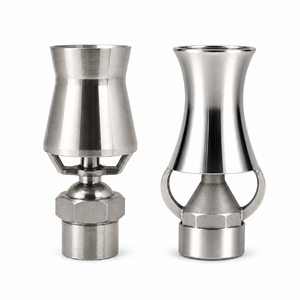
Geyser fountain nozzles—often referred to in fluid architectural terms as bubbler, foam, or atmospheric air-entrainment jets—represent one of the most visually dominant water visual features in modern landscape design. Operating through controlled air-water mixing ratios, these nozzles generate high-contrast, opaque white columns of water that maintain structural visibility even against turbulent wind conditions and intense ambient light.
When sourcing from leading fountain nozzle factories and suppliers in China, global engineering firms, landscape designers, and commercial contractors face a dual imperative: achieving exact hydraulic performance while ensuring long-term resistance to erosion, cavitation, and chemical degradation. China’s advanced manufacturing infrastructure has evolved from basic metal casting to high-precision CNC multi-axis machining, electro-polishing passivation, and computational fluid dynamics (CFD) modeled nozzle geometry.
The characteristic "foamy" volume of a geyser nozzle is achieved without requiring external compressed air lines. Instead, the nozzle leverages the Venturi effect: as high-velocity water is pushed through an internal contraction chamber, it creates a localized low-pressure drop that draws ambient atmospheric air through designated aspiration ports. This air is vigorously mixed into the water stream before discharge, resulting in an expanded, froth-rich vertical column.
Geyser nozzles are categorized into water-level dependent (require a stable pool level to drag surrounding water into the column) and water-level independent (internal mixing chambers unaffected by wave fluctuations). Premium Chinese factories offer both configurations engineered for precise head-loss compensation.
Unlike continuous laminar jets, air-aerated geyser columns break water momentum into micro-bubbles. This significantly softens splash impact and acoustic reverberation, making geyser jets ideal for indoor atrium features, commercial plazas, and interactive dry deck splash pads.
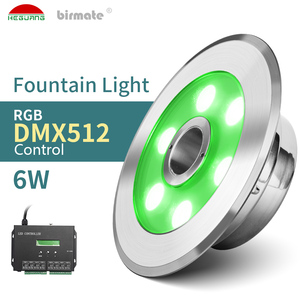
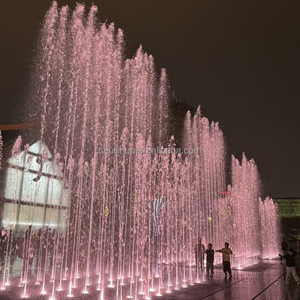
Because the ejected water column contains millions of micro-bubbles, it acts as a dense reflection medium for underwater RGBW LED lights. This provides vibrant refractive color saturation that plain clear water streams cannot achieve.
Selecting the appropriate fountain nozzle requires balancing hydraulic flow rate (GPM/LPM), pressure requirements (PSI/Bar), wind tolerance, visual opacity, and maintenance intensity. The comparative matrix below outlines key differences between Geyser Bubblers, Cascade Nozzles, and Laminar Jumping Jets.
| Nozzle Type | Aeration Level | Wind Resistance | Water Level Dependence | Primary Material Options | Illumination Efficiency |
|---|---|---|---|---|---|
| Geyser / Ice Pillar Jet | High (Venturi Air-Mixed) | Excellent (Dense Stream) | Independent / Configurable | SS316, Solid Cast Brass | High (Diffused Light Absorption) |
| Cascade / Foam Jet | Very High (Water-Water Mixing) | Moderate to Good | Strictly Level Dependent | Cast Bronze, Brass, SS304 | Very High (Opaque White) |
| Laminar / Jumping Jet | Zero (Glass-Rod Stream) | Low (Vulnerable to Crosswind) | Independent | SS316, Precision Acrylic Body | Internal Fiber-Optic / Core LED |
| Fan / Crown Nozzle | Low (Clear Sheet) | Low to Moderate | Independent | Machined Brass, Stainless Steel | Moderate (Surface Reflection) |
China’s top-tier fountain suppliers do not merely produce standardized off-the-shelf parts; they function as complete engineering partners. Combining decades of metallurgical innovation with fully integrated manufacturing capabilities, these suppliers adhere to rigid international quality frameworks.
Every jet body, internal swirl vane, and thread coupling is machined using advanced multi-axis CNC tooling. This guarantees uniform wall thickness, seamless thread engagement (BSP/NPT), and zero hydraulic asymmetry across mass installations.
Suppliers use verified AISI 304, AISI 316, or 316L stainless steel, alongside heavy-cast virgin brass. Stainless components undergo full chemical passivation and electropolishing to withstand chlorinated pool water and saline maritime air.
Leading factories collaborate directly with project architects. Utilizing Computational Fluid Dynamics, engineers simulate pressure drop, spray envelope, and discharge trajectory before physical casting or machining begins.
The global architectural water feature industry is undergoing a structural shift toward energy efficiency, intelligent control automation, and eco-friendly water treatment integration. Procurement managers must evaluate how China’s suppliers are leading these technological developments:
1. DMX512 & RDM Integrated Dynamic Sequencing: Modern geyser features are no longer static splash heads. High-speed solenoid valves and fast-acting digital water switches (such as programmable Y-switches and high-frequency solenoid modules) are now integrated directly into the nozzle manifold, allowing instantaneous water cut-off for musical dancing fountains.
2. Energy-Optimized Low-Head Hydraulic Designs: With global electricity costs rising, leading Chinese factories are re-engineering internal Venturi chambers to lower required pump pressure (PSI). By minimizing internal friction and turbulences, modern geyser nozzles achieve equal plume height with up to 25% less pump wattage.
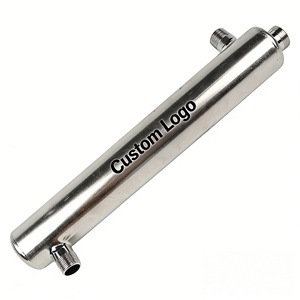
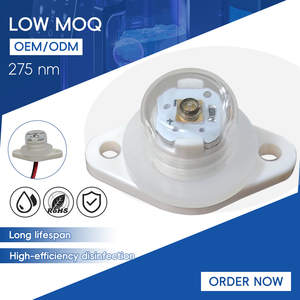
3. Inline UVC Sanitization & Water Safety: Public health standards for dry deck fountains, splash pads, and interactive city plaza jets require ultra-clean water recirculating systems. Sourcing packages now frequently bundle low-pressure drop geyser nozzles with high-output 275nm UVC LED inline sterilizer modules to eliminate pathogens without excessive chemical dosing.
To mitigate procurement risks such as material substitution (e.g., substituting SS201 for SS304), misaligned thread tolerances, or inconsistent aeration performance, international buyers should enforce the following 4-step quality audit framework:
Request an X-ray Fluorescence (XRF) alloy analysis report for stainless steel or brass batches. Ensure Nickel content in SS304 is ≥8.0% and in SS316 is ≥10.0% with added Molybdenum for chloride resistance.
Demand certified Head Loss vs. Discharge Rate (LPM/GPM) pressure curves. Qualified factories maintain indoor testing basins to record actual spray height and spray diameter across various pump pressure points.
Ensure threads conform strictly to ISO 7-1 (BSP) or ANSI B1.20.1 (NPT). Clean, burr-free threads with precision-machined seal seats prevent leakage under high-pressure dynamic water hammer conditions.
Connect directly with our engineering team for technical CAD specifications, CFD hydraulic flow simulations, bulk pricing, and custom OEM manufacturing solutions.
Contact Us