
0%

Choosing a fountain system in 2026 means looking beyond its catalog image. Prefabricated Fountain Systems can reduce on-site fabrication, but the right choice still depends on the site, water supply, and maintenance plan. A compact courtyard has different needs from a hotel plaza exposed to wind and heavy foot traffic. Measure the available footprint, note nearby drains, and check how technicians will reach pumps and filters.

Start with the effect you want. A low bubbling feature may suit a quiet garden, while taller jets need careful attention to wind drift and splash. Ask suppliers for pump curves, nozzle details, electrical requirements, and installation drawings—not only a brochure. Confirm what arrives assembled, what must be connected on site, and whether controls support scheduled operation or adjustable flow. Small details matter.

Materials deserve equal scrutiny. Compare basin construction, fittings, coatings, and access panels against the local climate and expected use. For colder locations, ask how the system drains and which components need seasonal protection. Water treatment, filtration, and routine cleaning also affect long-term operating costs. A lower purchase price may not mean a lower lifetime cost. That is easy to overlook.

This guide explains how to compare system types, specifications, suppliers, installation needs, and aftercare in 2026. It also considers energy use, lighting options, and water management without assuming every feature suits every project. Specifications can look reassuring on paper; they cannot replace a site review. Use them as a starting point, then verify the details with a qualified fountain professional before committing.
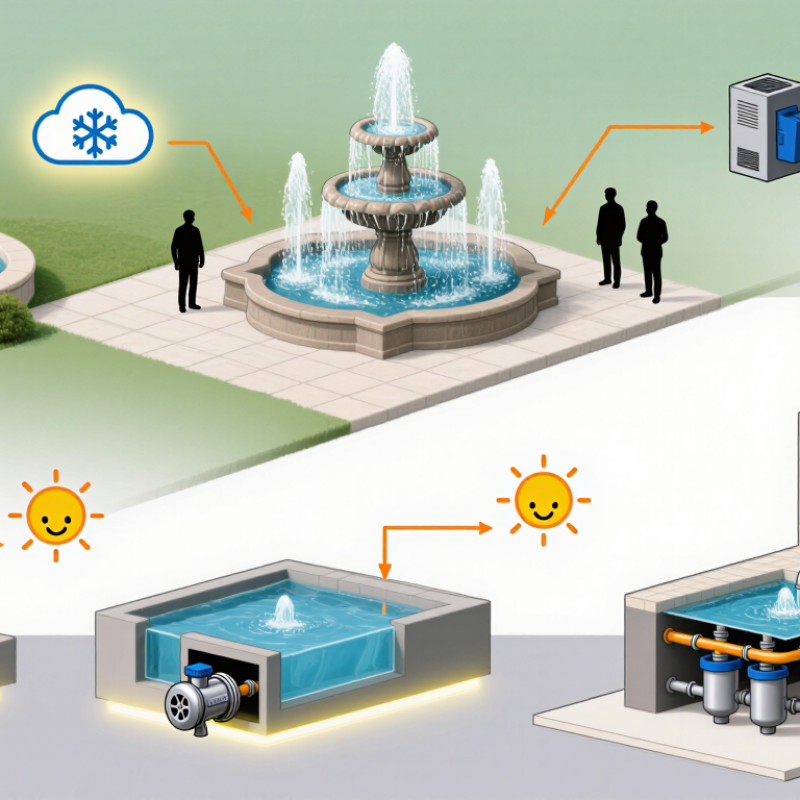
How to Choose Prefabricated Fountain Systems in 2026

Define Project Goals, Scale, and Performance Requirements

How to Choose Prefabricated Fountain Systems in 2026
Define Project Goals, Scale, and Performance Requirements

Before comparing prefabricated fountain systems, decide what the space should feel like and do. A quiet courtyard may need a low, steady water sheet, while a public plaza might call for visible jets and timed sequences. Measure the installation area, nearby paths, and viewing distance. A fountain that looks generous in a plan can feel cramped beside a bench or entrance. Start with the site. Check access for delivery and maintenance, too. Narrow gates and limited equipment space can complicate installation.

Translate those goals into measurable requirements. Ask suppliers for recommended basin dimensions, pump flow, electrical demand, operating noise, and routine maintenance needs. Confirm how the system handles wind, splash, drainage, and seasonal shutdowns for your local conditions. These details affect comfort and operating costs. Exact needs vary by site, and early estimates may change after a technical review. That is worth acknowledging, not hiding.

Tips: Mark the proposed footprint with tape before choosing a size. Compare actual pump and water-use figures, not just visual effects. Leave clear access to filters and controls. Keep a little flexibility in the budget; site preparation can reveal surprises. A simpler display may serve the project better, though it can feel less dramatic on paper. Decide which performance needs are essential and which are optional.

How to Choose Prefabricated Fountain Systems in 2026: Define Project Goals, Scale, and Performance Requirements

Use these calculated scenarios as a starting point for defining scale and performance—not as product specifications. Estimated pump input assumes water density of 1,000 kg/m³, gravity of 9.81 m/s², and 60% overall pump efficiency, using input power = ρ × g × flow × head ÷ efficiency. Actual requirements depend on nozzle selection, pipe losses, operating conditions, and the final system design.

Compare Prefabricated Fountain System Types and Configurations

Prefabricated fountain systems usually fall into three practical groups: self-contained basins, modular basin packages, and deck-level or pondless units. Self-contained units arrive with a vessel and basic pump arrangement, so installation can be quick where access is limited. Modular packages use joined panels or sections, allowing larger footprints and easier transport. Deck-level systems hide the reservoir but need careful access planning.

Compare configurations by more than appearance. A single-jet layout has fewer components and suits a quiet courtyard; multiple nozzles create broader movement but require balanced branches and more tuning. Check pump capacity against nozzle demand, pipe length, and elevation, rather than relying on a headline flow figure. Ask where filters, valves, and lights can be reached without draining the basin. That matters.

Material and site conditions shape the choice. Lightweight molded shells can simplify handling, while concrete-faced modular sections may better suit a rigid architectural edge. Durability still depends on construction and installation. Confirm dimensions, lifting points, overflow route, electrical provisions, and winterization method against the site drawings. A compact package can still be awkward to service. Leave room for hands and tools, not just water.

Assess Site Conditions, Utilities, and Installation Constraints

Before choosing a prefabricated fountain system, measure the proposed footprint and note changes in grade, nearby paving, and drainage. A level-looking lawn may still slope enough to expose a basin edge. Check soil stability and whether the filled structure will need a reinforced base. Ask for the system’s operating weight, not just its empty weight. Small details matter.

Map utilities before excavation. Confirm where water, power, and drainage lines enter the site, and identify any buried services. The pump’s electrical load, cable route, and access to a shutoff should be reviewed with a qualified electrician. Plan for overflow, too; rainwater should not collect against foundations or spill across walking paths. Leave room for maintenance access. It is easy to underestimate that space.

Installation constraints can change the best system choice. Measure gates, corridors, and turning areas for delivery, then check whether lifting equipment can reach the installation point. Consider nearby trees, wind exposure, freeze conditions, and noise-sensitive rooms. A detailed site drawing helps, but it will not capture everything. Recheck key dimensions in person before ordering; I would not rely on an old plan alone. If the site is tight, discuss assembly sequence and temporary access with the installer before the basin arrives.

Evaluate Materials, Pumps, Controls, and Water Management

When choosing a prefabricated fountain, match materials to the water and climate, not just the finish. Chlorinated water, coastal air, and freeze-thaw cycles can expose weak joints quickly. Compare stainless steel grades, basin liners, sealants, and access panels, then check how each part can be repaired. Small details matter. A removable pump screen is more useful than a polished panel that blocks routine access.

Size the pump for the actual lift, pipe length, and desired spray—not the catalog’s headline flow rate. The U.S. Department of Energy’s Improving Pumping System Performance: A Sourcebook for Industry reports that pumping systems can consume 25–50% of electricity in some industrial facilities. That figure is not a fountain estimate, but it shows why efficient pump selection and adjustable controls deserve attention. Use timers or variable-speed settings to reduce flow during quiet hours. Test the spray on site; wind can carry water beyond the basin.

Water management should be part of the specification. Include accessible drains, overflow routing, and a clear plan for cleaning filters and replacing water. The USGS estimated U.S. water withdrawals at 322 billion gallons per day in 2015, a broad national measure rather than a fountain-use figure. It still puts conservation in perspective. No datasheet predicts every site condition, and that is an easy point to overlook. Ask the installer to document expected refill frequency and seasonal shutdown steps.

Compare Costs, Maintenance Needs, and Supplier Support

Compare more than purchase prices. A prefabricated fountain may arrive ready to install, yet freight, lifting equipment, electrical work, and site drainage can change the final bill. Request an itemized quote and a five-year estimate covering pumps, lighting, filters, water treatment, and seasonal shutdowns. Ask how often filters need cleaning and whether replacement parts are standard sizes. Small details matter. A clogged intake can turn a quiet courtyard feature into a weekly maintenance task.

Check water and energy assumptions against your site. The U.S. Geological Survey’s 2015 water-use report estimated national withdrawals at 322 billion gallons per day, 9% below 2010 levels. That broad figure is not a fountain benchmark, but it makes water-loss monitoring worth discussing. Ask suppliers for expected flow, makeup-water needs, pump wattage, and a method for spotting leaks. Request operating estimates in writing. Then compare them using your local utility rates.

Supplier support is part of the cost. Confirm response times, warranty exclusions, remote troubleshooting, and parts availability before signing. The U.S. EPA’s WaterSense at Work guide recommends tracking water use and checking equipment for leaks. Ask whether the supplier can provide practical inspection steps and commissioning records. One awkward truth: projected maintenance figures are only as good as their assumptions. Have the supplier show what labor, climate, and operating hours those figures include.

How to Choose Prefabricated Fountain Systems in 2026 — Compare Costs, Maintenance Needs, and Supplier Support
System type Typical equipment-package budget (USD) Best suited for Routine maintenance needs Relative maintenance effort Supplier support to confirm before purchase
Self-contained recirculating fountain $2,000–$12,000 Small courtyards, patios, and entry areas where a compact basin and simple water display are preferred. Remove leaves and debris regularly; clean the basin and pump intake; check water level and inspect the pump and electrical connections. Winterize where freezing conditions occur. Low to moderate Ask whether the package includes the pump, filtration, controls, and installation instructions. Confirm replacement-part availability and the recommended winterization procedure.
Modular basin or pondless system $5,000–$25,000 Commercial landscapes and public spaces needing a larger visual feature with a concealed or modular water reservoir. Keep reservoir screens and pump intakes clear; check water level, leaks, and water quality; inspect accessible plumbing and clean filters as directed. Moderate Confirm the reservoir capacity, access for pump servicing, parts list, commissioning guidance, and who handles troubleshooting if the installed components come from multiple suppliers.
Prefabricated tiered or architectural fountain $8,000–$40,000 Plazas, gardens, and building entrances where a visible, decorative centerpiece is required. Clean basins and nozzles to limit mineral deposits and debris; monitor water level and pump operation; inspect joints, finishes, and splash patterns. Hard water may require more frequent cleaning. Moderate to high Request lifting and assembly instructions, finish-care guidance, pump and nozzle specifications, spare-part lead times, and written warranty coverage for both structure and mechanical components.
Interactive, ground-level splash fountain $40,000–$150,000+ Public parks and civic spaces designed for active play, typically with flush nozzles, controls, and water-treatment equipment. Inspect nozzles and drains; clean strainers; check pumps, sensors, and controls; monitor water-treatment readings and maintain treatment equipment according to applicable health requirements. High Confirm operator training, water-treatment documentation, control-system support, seasonal opening and closing procedures, emergency service availability, and the local authority requirements the design is intended to meet.
Large modular plaza fountain $25,000–$100,000+ Large civic or commercial sites needing multiple water effects, coordinated controls, or a custom layout built from prefabricated components. Schedule routine cleaning and inspections; check pumps, filters, valves, lighting, controls, and water levels; plan periodic service for wear parts and seasonal shutdown where needed. High Ask for a component schedule, system diagrams, commissioning and maintenance manuals, operator training, service response terms, and a clear division of responsibility among the system supplier, installer, and local service contractor.

Budget note: These are indicative 2026 planning ranges for equipment packages, not supplier quotations. They generally exclude site preparation, excavation, foundations, utility upgrades, drainage, shipping, taxes, installation, and ongoing service. Actual costs depend on size, materials, water treatment, controls, local labor, and site conditions. Ask suppliers to price the same scope and list inclusions and exclusions.

Selection tip: Compare the full ownership picture—not only the purchase price. Request a written maintenance schedule, warranty terms, parts availability, training details, and a named route for technical support before choosing a system.

FAQS

What should I check at the installation site?

Measure the footprint, slopes, gates, and delivery path. Check soil stability and the fountain’s filled weight. Small details matter.

How should I plan utilities and drainage?

Locate buried services, water lines, and electrical access before excavation. Have a qualified electrician review the pump load and cable route. Plan overflow away from foundations and walkways.

Which materials suit my climate?

Compare basin liners, sealants, joints, and access panels against local water and weather. Coastal air and freeze-thaw cycles can expose weak parts. Easy repairs matter more than a glossy finish.

How do I choose the right pump?

Match pump capacity to lift height, pipe length, and spray pattern. A headline flow rate alone may mislead. Test the spray outdoors; wind can carry water over the basin edge.

What water-management features should I request?

Ask for accessible drains, overflow routing, and clear filter-cleaning instructions. Get expected refill frequency and seasonal shutdown steps in writing. Leaks waste water quietly.

What costs belong in the budget?

Compare itemized quotes, including freight, lifting equipment, electrical work, and drainage. Request a five-year estimate for pumps, filters, lighting, and seasonal care. Local utility rates change the picture.

How can I estimate ongoing maintenance?

Ask how often filters need cleaning and whether replacement parts use standard sizes. Request pump wattage, expected water use, and leak-check instructions. Estimates depend on their assumptions.

What supplier support should I confirm?

Check response times, warranty exclusions, troubleshooting options, and parts availability. Ask for commissioning records and practical inspection steps. I would still verify the details in person.

Conclusion

Choosing Prefabricated Fountain Systems in 2026 starts with clearly defining the project’s purpose, scale, visual goals, and performance requirements. Consider whether the installation is intended for a compact courtyard, a public plaza, or a larger landscape, then compare system types and configurations to find an option suited to the desired water effects and available space. Site conditions also matter: assess access for delivery and installation, ground and drainage conditions, and the availability of electrical and water connections before selecting a system.

Next, evaluate the materials, pumps, controls, and water-management features that will influence reliability and day-to-day operation. Compare initial costs alongside expected maintenance, energy use, and the effort required to keep the fountain clean and functioning well. Finally, review the supplier’s installation guidance, technical documentation, replacement-part availability, and ongoing support. A well-informed choice balances appearance, practical site needs, long-term upkeep, and overall value.

Charlotte

Charlotte

Charlotte is a dedicated marketing professional who brings a strong understanding of the company’s products and a thoughtful, customer-focused approach to every article she writes. Through regular contributions to the company’s professional blog, she explains product features, practical......