0%

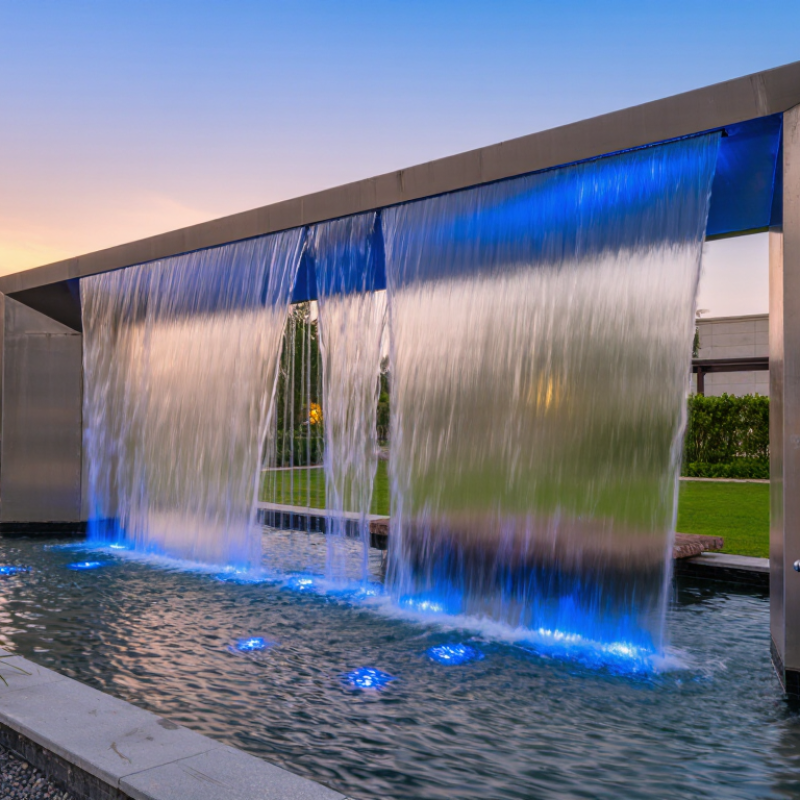
China’s best Waterfall Water Effects are becoming practical choices for hotels, shopping centers, resorts, and private landscape projects. Global buyers now expect more than attractive falling water. They need stable pumps, quiet operation, accurate lighting, safe materials, and clear maintenance records. Grand View Research’s water fountain market analysis identifies rising demand for decorative water installations in commercial and hospitality environments. Its findings support a broader shift toward immersive outdoor experiences.

Mark Fuller, founder of WET Design, once said, “Water is the most powerful medium on Earth.” His observation explains why a controlled waterfall can change an entrance within seconds. A thin sheet of water can reflect blue LEDs like glass. A wider cascade can create movement, sound, and a memorable arrival point. The design must still respect the site’s climate, drainage, electricity supply, and visitor safety.

The China supply market offers customization, including stainless-steel panels, adjustable flow systems, LED synchronization, and modular installation. However, “best” is not universal. A resort near the coast may need stronger corrosion resistance. A shopping mall may prioritize low noise and compact filtration. A buyer should request pump curves, material specifications, water-quality guidance, factory inspection evidence, and destination-specific conformity documents. ISO-based quality procedures can strengthen confidence, but certificates alone cannot replace practical testing. That part is often missed.

Reports from Allied Market Research and Grand View Research also point to continuing investment in landscape design and experiential commercial spaces. Still, market forecasts are not guarantees. Supplier performance, engineering accuracy, and after-sales support decide the real outcome. This guide examines how global buyers can evaluate China-made Waterfall Water Effects with clearer expectations and fewer costly surprises.

China Best Waterfall Water Effects for Global Buyers?

Waterfall Water Effects: Types, Flow Rates, and 1–3 m Blade Widths

China Best Waterfall Water Effects for Global Buyers?

Waterfall water effects usually fall into three types: smooth sheets, broken cascades, and thin laminar streams. Each creates a different sound, splash pattern, and maintenance burden.

For a 1 m blade

a practical starting flow is 5–10 L/s.

A 2 m blade may need 10–20 L/s, while a 3 m blade often requires 15–30 L/s. These figures are design ranges, not guarantees. The final rate depends on lip thickness, water depth, pump head, and air movement. ASHRAE Handbook—HVAC Applications (2023) links evaporation and water loss to temperature, humidity, and exposed surface area. That matters in outdoor installations.

Blade width changes visual scale.

A 1 m sheet suits entrances, courtyards, and compact hotel features.

A 2 m blade creates stronger presence but needs better leveling and splash control.

Three meters can look impressive. It can also reveal every construction error.

Hydraulic Institute pump-system guidance supports checking duty flow, total dynamic head, and pump efficiency before purchase. I would not trust a flow number without a site test. Beautiful water is not always efficient water.

Tips:

Ask suppliers for flow curves, not only pump horsepower. Test the blade at low, medium, and peak flow. Check noise, splash distance, and water recovery.

EPA WaterSense at Work identifies decorative water systems as opportunities for water-management improvements.

A cover, level sensor, and filtration plan can reduce unnecessary makeup water.

Small details matter. Some buyers still overlook them.

Hydraulic Design: 20–60 L/min Flow and 1.5–3.0 m Pump Head

China Best Waterfall Water Effects for Global Buyers?

A convincing waterfall begins with controlled hydraulics, not excessive flow. The target range of 20–60 L/min equals approximately 0.33–1.0 L/s. With a pump head of 1.5–3.0 m, this range suits compact hotel features, villa gardens, and indoor displays. A 1.2-meter cascade may need less head than a raised wall with long pipework. Friction losses matter.

Hydraulic power remains modest. At 60 L/min and 3.0 m head, theoretical output is about 29 watts, before efficiency losses. A practical pump may require roughly 50–70 watts, depending on motor and plumbing design. The U.S. Department of Energy’s Pumping System Assessment Tool emphasizes that system efficiency depends on the whole circuit, not only the pump. This is often overlooked.

Field testing should confirm flow at the outlet, not just on the specification sheet. Pipe bends, filters, valves, and elevation can reduce visible sheet thickness. ANSI/HI hydraulic guidance also highlights the importance of adequate inlet conditions and avoiding air entry. Water quality changes the result; mineral deposits can narrow small outlets over time. The 20–60 L/min range is useful, but not universal. A wider spillway may look weak at 20 L/min. A narrow slot may splash at 60 L/min. Designers should test several settings, record noise, and inspect the falling sheet from different viewing distances.

Material Selection: 304/316 Stainless Steel and 2–3 mm Sheet Thickness

China Best Waterfall Water Effects for Global Buyers?

Material selection controls the sound, shine, and service life of a waterfall feature. For indoor freshwater installations, 304 stainless steel often provides a practical balance between corrosion resistance, availability, and fabrication cost. Coastal air, chlorides, and treated water can challenge it. Grade 316 contains molybdenum and generally offers stronger resistance in chloride-rich environments, according to the Nickel Institute’s stainless steel guidance.

Sheet thickness also affects performance. A 2–3 mm stainless sheet can create a clean, continuous water film when properly supported. However, thickness alone does not prevent vibration or oil-canning. The final design should consider span length, water pressure, welded stiffeners, and concealed framing. I have seen thin panels perform well with close support, while thicker panels failed because their internal structure was poorly aligned.

The World Stainless 2024 statistical report recorded approximately 60.3 million tonnes of global crude stainless steel production in 2023. This scale supports broad material availability, but it does not make every sheet suitable for a waterfall. Buyers should request mill certificates, surface-finish details, weld-passivation records, and water-flow testing. For visible surfaces, a uniform No. 4 or finer finish can reduce distracting reflections. Still, this is not universal; lighting, viewing distance, and local water chemistry can change the result.

This chart compares the calculated mass of 304 and 316 stainless steel sheets commonly considered for waterfall water-effect fabrication at 2.0–3.0 mm thickness. Values are based on nominal densities of 7.93 kg/L for 304 stainless steel and 7.99 kg/L for 316 stainless steel, using a one-square-metre sheet area. Actual weight may vary slightly with production tolerances and surface finish.

Quality Testing: ±10% Flow Tolerance, Leak Tests, and 50 Hz Compatibility

China’s best waterfall water effects should be judged by measured performance, not polished photographs. For global buyers, a ±10% flow tolerance is a practical screening limit. It helps maintain a steady curtain, even when pipe length, water temperature, or installation height changes. Each unit should be tested at its rated head and flow, with readings recorded in a signed inspection sheet.

Leak testing must cover the pump chamber, seals, welds, fittings, and drainage points. ISO 9906:2012 provides a recognized framework for hydraulic pump acceptance testing, while Hydraulic Institute guidance supports testing near the actual operating point. A dry test is not enough. Water should circulate for a defined period, and joints should remain visibly dry. Small drips become expensive problems.

Electrical compatibility also needs evidence. IEC 60038 identifies 50 Hz as a standard supply frequency in many international systems, but voltage and plug requirements still vary by market. Suppliers should state frequency, voltage range, motor insulation class, and protection rating clearly.
The U.S. Department of Energy’s pumping-system guidance emphasizes matching pumps to real operating conditions for better efficiency. That sounds obvious. It is often missed. Buyers should request factory test videos, calibrated meter records, and retesting after installation, because ±10% on paper may not look the same beside a real stone wall.

Global Buyer Checks: CE, RoHS, IP65 Ratings, Packaging, and MOQ Terms

For global buyers, waterfall water effects should pass a practical compliance check before price discussions. CE marking indicates conformity with applicable European Union requirements, but it is not a universal quality certificate. Request the Declaration of Conformity, technical file summary, and test reports matching the exact model. RoHS compliance matters for electrical parts, especially controllers, pumps, and LED modules. Directive 2011/65/EU, expanded by Delegated Directive 2015/863, restricts ten substances. The Global E-waste Monitor 2024 reports 62 million tonnes of e-waste generated in 2022. Material traceability is therefore more than paperwork.

IP65 is useful for outdoor installations, but buyers should read the test conditions carefully. Under IEC 60529, the first “6” means dust-tight protection, while “5” means protection against water jets. It does not prove safe immersion. Ask for gasket details, cable-entry design, and a sample test under realistic spray angles. Small leaks often appear after transport, not in a showroom.

Packaging needs equal attention. Foam protection, moisture barriers, corner supports, and shock indicators can reduce damage, yet excessive packaging increases disposal costs. Confirm carton dimensions, pallet loading, drop-test records, and replacement-part procedures. MOQ terms should state quantity, color, voltage, spare parts, sample fees, and lead time. A low MOQ sounds attractive. Sometimes it hides higher unit costs. I would request one production sample before accepting a large order, because certificates can match paperwork while the delivered product changes.

China Best Waterfall Water Effects for Global Buyers? - Global Buyer Checks: CE, RoHS, IP65 Ratings, Packaging, and MOQ Terms
Buyer Check Typical Product Data What the Specification Means Documents or Inspection Points Typical Export Packaging Indicative MOQ / Terms
Waterfall Effect Type LED waterfall curtain, water blade, or linear water outlet Creates a continuous sheet or segmented streams of water for indoor and outdoor decorative installations. Confirm water-flow uniformity, outlet spacing, operating noise, splash control, and compatibility with the planned pump system. Foam-protected inner box with a five-layer export carton; stainless-steel parts may use protective film. 1 sample for testing; bulk order commonly starts from 10–50 units.
LED Lighting RGB or RGBW LEDs; 12 V DC or 24 V DC; commonly 6–18 W per metre Low-voltage lighting is generally easier to integrate with control systems and reduces electrical risk near water when correctly installed. Check input voltage, power consumption, LED lifetime declaration, controller protocol, cable length, and spare-parts availability. Individual protective bags, foam separators, cable protection, and moisture-resistant cartons. Sample approval before production; custom colours or lengths may require a higher MOQ.
CE Compliance Required for applicable EU-market products CE marking indicates that the manufacturer declares conformity with applicable European Union product requirements. It is not a quality grade or a universal safety certificate. Request the EU Declaration of Conformity and applicable test reports. Verify that the documents match the exact model, voltage, controller, and power supply. Keep compliance documents in the shipment file or provide them electronically to the importer. Usually no MOQ for document review; certification or testing fees may apply to customized designs.
RoHS Compliance Commonly requested for EU electrical products RoHS restricts certain hazardous substances in electrical and electronic equipment, including lead, mercury, cadmium, and several other restricted substances. Request a product-specific RoHS declaration or laboratory report. Confirm that cables, solder, LEDs, circuit boards, and power supplies are covered. Use the same model number on packaging, invoice, declaration, and test report to maintain traceability. Normally available for standard products; custom materials may require additional testing.
IP65 Rating Dust-tight and protected against water jets The first digit, 6, indicates complete protection against dust. The second digit, 5, indicates protection against water jets from any direction. IP65 does not mean the product is suitable for immersion. Check whether the rating applies to the complete assembly or only to the LED module. Inspect seals, cable glands, connectors, and enclosure joints. Use sealed bags or moisture-resistant wrapping inside cartons, especially for long-distance sea freight. Standard IP65 components may be available from 1 sample; customized housings may require 20–100 units.
Water and Electrical Safety Low-voltage lighting with a separately installed outdoor-rated power supply Water features should use suitable residual-current protection, grounding, cable routing, and separation between mains voltage and wet areas. Verify power-supply input/output ratings, grounding provisions, cable insulation, connector sealing, and installation instructions. Final installation must follow local electrical codes. Power supplies should be packed separately with shock-absorbing material and clear identification labels. One complete sample set for technical approval; replacement parts should be quoted separately.
Material Options 304 stainless steel for general outdoor use; 316 stainless steel for salt-air or coastal environments Higher-grade stainless steel generally offers improved resistance to chloride exposure, although maintenance and site conditions still affect service life. Request material grade confirmation, surface-finish details, weld quality, dimensions, and corrosion-resistance expectations for the installation environment. Protect polished surfaces with film, foam, corner guards, and a reinforced carton or plywood crate for long items. Standard lengths may start at 5–20 units; custom lengths and finishes may require 20–50 units.
Water Flow Requirement Common design range: approximately 0.5–3.0 m³/h per metre, depending on outlet design and waterfall height Actual flow depends on outlet width, head height, pump curve, pipe diameter, filtration, and the required visual effect. The value must be confirmed by hydraulic testing. Request a flow-versus-height chart, pump recommendation, inlet size, water-quality requirements, and maximum allowable debris size. Pipe fittings and nozzles should be bagged, labelled, and separated to prevent scratches or loss during transit. Quotation should identify whether the pump, filter, controller, and pipework are included.
Product Dimensions Typical modular widths: 0.5–2.0 m per section; customized lengths available Modular sections simplify transport, installation, replacement, and alignment across large commercial projects. Confirm overall dimensions, mounting holes, water inlet position, cable exit location, allowable tolerance, and connection method. Long sections may require reinforced cartons or plywood cases with internal bracing. Custom dimensions commonly require a technical drawing and an agreed minimum order quantity.
Packaging and Freight Export carton for compact units; plywood case for fragile, heavy, or oversized assemblies Packaging should protect against impact, vibration, moisture, deformation, and corrosion during road, air, or sea transport. Check gross weight, net weight, carton dimensions, packing list, HS classification, shipping marks, and pallet requirements. Moisture barrier, desiccant, foam, corner protection, shock labels, and fumigated plywood where required by destination rules. Freight cost should be calculated from packed dimensions and weight, not product dimensions alone.
Quality Inspection Pre-shipment inspection covering appearance, dimensions, electrical operation, water flow, and lighting function A documented inspection reduces the risk of receiving mismatched colours, leaking joints, damaged finishes, or incomplete accessories. Agree on an inspection checklist, acceptable tolerances, photo records, sampling level, and corrective-action procedure before production. Photographs of inner packing, outer cartons, labels, and loaded cargo should be retained for traceability. Inspection may be performed by the buyer, an independent inspector, or an agreed third party.
MOQ and Commercial Terms Sample order: 1 set; standard production: commonly 10–50 sets; custom projects: project-based quotation MOQ depends on material, dimensions, LED configuration, controller type, packaging method, and tooling requirements. Confirm quotation validity, lead time, payment schedule, warranty scope, spare-parts policy, Incoterm, and responsibility for import taxes. Specify whether packaging, labels, manuals, spare parts, and export documentation are included in the quoted price. Typical terms may include a paid sample, partial deposit before production, and balance after inspection or before shipment.
Warranty and After-Sales Support Common commercial warranty period: 12–24 months, subject to written terms Warranty coverage should clearly distinguish manufacturing defects from incorrect installation, chemical damage, freezing, blocked filtration, or unauthorized modification. Request troubleshooting instructions, wiring diagrams, replacement-part pricing, response time, and the process for warranty claims. Include a small percentage of recommended spare LEDs, seals, connectors, and nozzles for project maintenance. Agree on replacement-part MOQ and whether defective parts are replaced, credited, or repaired.

FAQS

What types of waterfall water effects are available?

Common designs include smooth sheets, broken cascades, and thin laminar streams. Each creates different sound and splash patterns. Maintenance needs also vary.

What flow rate suits a 1–3 meter waterfall blade?

A 1-meter blade often starts at 5–10 liters per second. A 2-meter blade may need 10–20 liters per second. A 3-meter blade may require 15–30 liters per second. These are design ranges, not guarantees.

How does blade width affect installation?

A 1-meter blade suits entrances, courtyards, and compact indoor displays. A 2-meter blade creates stronger visual presence. It needs better leveling and splash control. A 3-meter blade looks impressive. It also exposes small construction errors.

Is 20–60 liters per minute suitable for compact water features?

This range equals about 0.33–1.0 liters per second. It can suit villas, hotel displays, and garden installations. A wide spillway may look weak at 20 liters per minute. A narrow slot may splash at 60 liters per minute.

What pump head is commonly needed?

A pump head of 1.5–3.0 meters suits many compact designs. Long pipework, bends, filters, and elevation increase friction losses. The outlet flow may be lower than the catalog figure. I would still test it onsite.

How should buyers verify the actual water flow?

Test the outlet at low, medium, and peak settings. Measure sound, splash distance, and sheet thickness. View the waterfall from several distances. A specification sheet can mislead.

How can users reduce water loss and maintenance?

Use a cover, level sensor, filtration plan, and reliable water recovery system. Outdoor evaporation increases with heat, dry air, and exposed surface area. Mineral deposits can narrow small outlets over time. Small details matter.

What compliance and protection documents should buyers request?

Request conformity documents, electrical test reports, and material compliance records. Check that documents match the exact supplied model. An IP65 rating protects against dust and water jets. It does not prove safe underwater use.

What packaging and order terms need checking?

Confirm foam protection, moisture barriers, corner supports, and shock indicators. Request carton dimensions, pallet details, and transport test records. Order terms should state quantity, voltage, color, spare parts, and lead time. A low minimum order quantity may hide higher unit costs. One sample helps.

Conclusion

Waterfall Water Effects are a practical solution for creating attractive, consistent water features in commercial and residential projects. Buyers can choose from different water patterns, flow styles, and blade widths, typically ranging from 1 to 3 meters. A suitable hydraulic design should provide approximately 20–60 L/min of water flow with a pump head between 1.5 and 3.0 meters, helping maintain a smooth and stable cascade under different installation conditions.

Material and quality control are also essential for reliable international purchasing. Stainless steel grades 304 or 316, combined with a sheet thickness of about 2–3 mm, can provide suitable strength and corrosion resistance. Before shipment, products should be checked for flow performance within a ±10% tolerance, leakage, and compatibility with 50 Hz power systems. Global buyers should also review CE, RoHS, and IP65 documentation, as well as packaging protection, minimum order quantities, delivery terms, and installation requirements.

Amelia

Amelia

Amelia is a dedicated marketing professional with a deep understanding of the company’s products, customers, and market environment. With a strong combination of strategic thinking, industry knowledge, and clear communication skills, she creates informative content that helps readers better......