
In 2026, the best Interactive Water Features will do more than decorate a plaza or cool a summer crowd. They will invite people to step closer, make choices, and shape what happens next. A child’s hand triggers a fan of water; a timed sequence sends bright arcs across a shallow basin. Small moments matter.
The broader attractions sector offers useful context. The 2023 TEA/AECOM Theme Index reported 201.7 million visits across the world’s top 25 theme parks, a 23.1% increase from 2022. That figure does not measure water features specifically, but it signals renewed attention to memorable, participatory experiences. Design teams must also consider operating resources. UNESCO’s 2024 World Water Development Report notes that agriculture accounts for about 70% of global freshwater withdrawals. For water features, recirculation, leak detection, and thoughtful controls are practical design priorities—not decorative extras.
Industry experience adds another lens. Mark Fuller, founder of water-feature design firm WET, is known for treating water as a choreographed medium for public experience. That idea helps frame the choices ahead, although a striking show alone is not enough. Look for clear accessibility, visible safety cues, comfortable edges, and controls that respond reliably. Can the feature engage a toddler and still interest an adult? Can operators maintain it without guesswork? This guide compares standout approaches for 2026, weighing sensory appeal, participation, durability, and responsible water use.
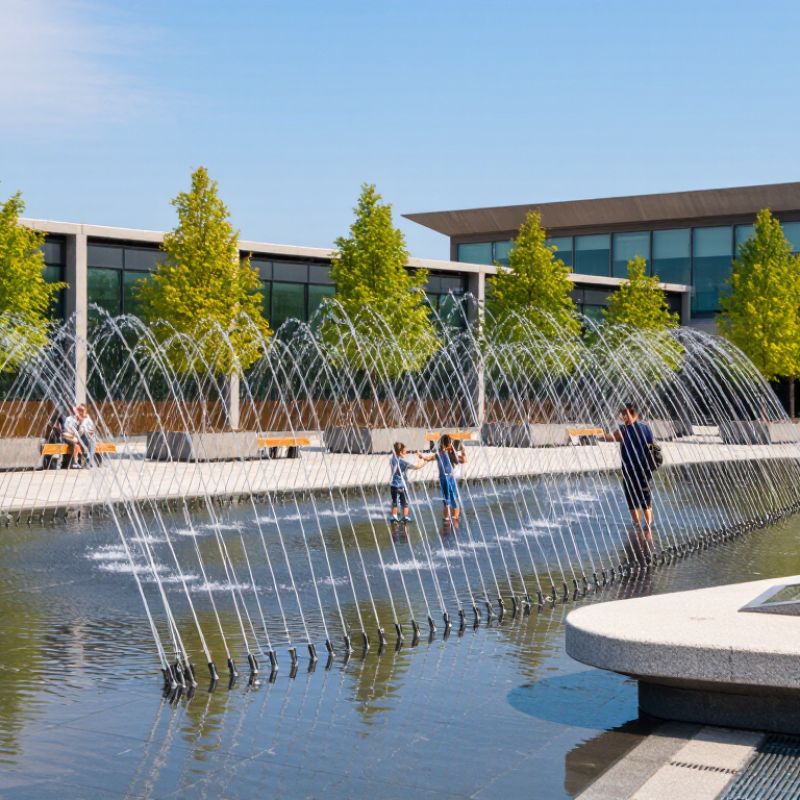
Interactive water features invite people to touch, redirect, or trigger water. Examples include splash pads, ground jets, shallow channels, and sensor-activated sprays. Unlike decorative fountains, they encourage direct participation. Core systems include pumps, filters, treatment equipment, controls, drains, and slip-resistant surfaces. In a plaza, a child might step on a pad and send a short arc across the paving.
These features support recreation, cooling, and lively public spaces. But operation requires more than playful design. The U.S. Environmental Protection Agency reports that landscape irrigation accounts for nearly one-third of residential water use nationally, or almost 9 billion gallons daily. That figure does not measure splash-pad demand directly. It does underline the value of tracking water use, capturing runoff, and considering recirculation. Small details matter. Accessible shutoffs and properly sized filters can be less visible than jets, yet they affect upkeep.
For public aquatic venues, the CDC’s Model Aquatic Health Code offers technical guidance on circulation, filtration, disinfection, and water quality. It is guidance, not a substitute for local requirements or site-specific engineering. Operators should plan for drainage, clear sightlines, accessible routes, and seasonal shutdowns. Sensors may limit unnecessary spraying, but they also need testing and repair. That trade-off is easy to underestimate. A feature that feels effortless to visitors may require daily checks behind the scenes.
Interactive water features invite movement, but each type creates a different kind of play. Splash pads spread activity across ground-level jets, making them easy to enter and watch. Interactive fountains add timed sprays and changing patterns; children can trigger the water themselves. Water play walls turn small channels, gates, and hand pumps into hands-on experiments. They use less floor space, though queues can form around popular controls. Simple wins.
Choose by age range, shade, drainage, and supervision—not appearance alone. The CDC estimates about 4,000 fatal unintentional drownings occur in the United States each year, underscoring the value of clear sightlines and thoughtful water management. This figure covers drowning broadly, not injuries at splash pads or fountains. A lively feature can still feel exposed on a hot, treeless site; that trade-off deserves a second look.
Tips: Test controls at a child’s height, check that wet surfaces drain quickly, and plan comfortable seating near the play zone. Separate fast-moving spray from quieter wall play where space allows. Ask staff to observe peak-hour use before finalizing the layout; the first plan is rarely perfect.
An interactive water feature is only accessible when visitors can reach its controls, spray zones, and resting areas. The 2010 ADA Standards for Accessible Design, section 403.3, set a maximum cross slope of 1:48 on accessible routes—about 2.1 percent. In practical terms, the surface may rise no more than one inch across 48 inches. This limit matters near splash pads, where drains, wet paving, and subtle grade changes meet. Section 302.1 also calls for walking surfaces that are firm, stable, and slip-resistant. Check these qualities under wet conditions, not only on dry samples. A drawing can look perfect. Wet shoes disagree.
The U.S. Access Board’s Guide to the ADA Accessibility Standards explains how route requirements apply to walking surfaces and changes in level. Use a digital level or survey equipment to verify cross slope after paving, then repeat checks near drains and play features. Construction tolerances and settlement can alter the finished grade. Keep the accessible route clear of hoses, loose mats, and standing water, and ensure visitors can approach interactive elements without crossing a steep or obstructed area. A compliant measurement at handover is useful, but it does not guarantee performance after heavy use. Maintenance teams need a simple inspection routine, and designers should allow drainage without directing runoff across the route. That balance is easy to underestimate.
Interactive water features in 2026 should welcome more people, not just create visual drama. During site reviews, I look for firm, slip-resistant paths around the water. Wide turning areas help wheelchair users and families with strollers. Controls should sit within comfortable reach, with clear symbols and tactile feedback. Quiet audio signals can support visitors with limited vision, but excessive sound becomes tiring.
Water reuse now deserves equal attention. A properly sized collection tank can capture splash and runoff for filtered recirculation. Sensors can monitor water level, clarity, temperature, and pump performance. Automatic shutoff reduces waste when leaks or unsafe conditions appear. Still, reuse systems need careful treatment and regular testing. Clean-looking water is not always safe water.
Remote controls can simplify scheduling, fault alerts, and seasonal adjustments. They should not replace on-site checks. I have seen a small blocked filter reduce spray height within hours. Maintenance teams need accessible pumps, labeled valves, and safe drainage points. Weekly inspections may suit a busy public plaza, while smaller installations need a practical schedule based on usage. No feature is maintenance-free. Designers sometimes underestimate winter protection and replacement costs. That mistake can turn an engaging fountain into an expensive obstacle. The best choice balances playful interaction with dependable access, measurable water savings, and realistic daily care.
| Interactive Feature Type | Best 2026 Use Case | Accessibility Considerations | Water-Reuse Approach | Recommended Controls | Maintenance Profile | Overall Selection Profile |
|---|---|---|---|---|---|---|
| Zero-Depth Interactive Splash Pad | Public parks, civic plazas, family recreation areas, and cooling spaces. | Provides level, step-free access when the surrounding surface is designed as an accessible route. Include slip-resistant surfacing, clear circulation space, accessible controls, and edge protection. A turning space of approximately 60 inches is commonly used where a wheelchair must turn. | Usually designed as a recirculating system with collection drains, filtration, disinfection, automatic makeup-water control, and overflow management. Potable makeup water may still be required. | Programmable sequencing, push-button or proximity activation, timed operating cycles, water-level sensors, leak detection, pump protection, remote alerts, and automatic shutdown. | High public-use intensity. Requires frequent inspection of drains, nozzles, grates, filters, water quality, slip resistance, and surrounding drainage. Seasonal winterization may be necessary in freezing climates. |
Best all-round public option Strong engagement and accessibility potential, but it has comparatively high design, sanitation, and maintenance requirements. |
| Interactive Jet Fountain | Urban plazas, hospitality developments, cultural destinations, and compact public spaces. | Can be made accessible with flush or nearly flush paving, level approaches, accessible activation points, visual contrast, audible cues, and slip-resistant finishes. Avoid isolated controls that require reaching across water jets. | Typically uses an underground collection basin with recirculation, filtration, disinfection, automatic top-up, and overflow diversion. A cover or secure access system helps protect the reservoir. | Variable-frequency pump control, individual valve control, programmable light and jet scenes, wind monitoring, water-level sensing, emergency stop, and scheduled operating hours. | Moderate to high. Nozzles can clog, pumps require inspection, and paving joints and grates need regular cleaning. Water chemistry and electrical equipment should be checked on a documented schedule. |
Best for visual impact in limited space Offers strong programming flexibility, but moving parts and flush-mounted equipment require careful access planning. |
| Interactive Water Wall | Building entrances, courtyards, museums, retail environments, and quieter social spaces. | Provide a step-free route, accessible viewing areas, detectable edges where needed, non-glare surfaces, and controls within an accessible reach range. Protect circulation routes from splash and overspray. | A concealed collection trough and recirculating reservoir can substantially reduce the need for continuous fresh water. Overspray control and efficient water distribution are important for reducing losses. | Digital scheduling, pump-speed control, low-level sensors, leak alarms, lighting control, and automatic shutdown during abnormal flow or water-level conditions. | Moderate. Inspect the collection trough, pumps, filter, water distribution openings, sealants, and nearby drainage. Mineral deposits may be visible on hard surfaces and require routine cleaning. |
Best for controlled architectural settings Good visual appeal with lower user-contact intensity than a splash pad, making operating procedures simpler in many locations. |
| Interactive Mist or Fog System | Heat-relief zones, shaded plazas, event areas, and temporary or seasonal installations. | Use slip-resistant paving, maintain clear visibility, control overspray, and provide an accessible route around the misting zone. Avoid creating slippery transitions between dry and wet surfaces. | Water demand can be reduced through timed activation, occupancy sensors, high-efficiency nozzles, and automatic shutoff. Water treatment requirements depend on the system design and whether water is recirculated. | Temperature and humidity sensors, occupancy detection, timed cycles, pressure monitoring, remote status reporting, and automatic shutdown for low pressure or leaks. | Moderate to high. Fine nozzles are sensitive to sediment and mineral buildup. Filters, water quality, pipe sanitation, and seasonal draining require close attention. |
Best for targeted cooling Efficient when operated intermittently, but nozzle hygiene, aerosol management, and slip prevention must be addressed. |
| Interactive Rill or Shallow Runnel | Landscape-led public spaces, educational gardens, resorts, and nature-focused developments. | Keep crossings level and stable, provide edge protection where depth or flow creates a hazard, use slip-resistant surfaces, and maintain an accessible bypass route if the water channel interrupts circulation. | Can use recirculation through a settling chamber, screen, filter, and treatment loop. Water losses mainly arise from evaporation, splash, cleaning, and drainage during maintenance. | Flow-speed control, timed circulation, water-level monitoring, pump protection, weather-based scheduling, and low-flow or dry-run shutdown. | Moderate. Leaves, sediment, algae, litter, and biological growth can accumulate in shallow channels. Cleaning access and safe isolation points should be incorporated into the design. |
Best for sensory and educational value Creates a strong connection with landscape design, but it needs effective sediment management and carefully designed crossings. |
| Interactive Bubblers and Ground Geysers | Small plazas, play areas, residential amenity spaces, and retrofit projects. | Flush installation, accessible approach routes, high-contrast markings, slip-resistant paving, and controls that can be used without stepping into the active spray zone improve usability. | Works well with a compact recirculating basin, filtration, disinfection, water-level sensing, and programmed spray intervals. Separate drainage and collection zones help manage runoff. | Individual solenoid valves, push-button or sensor activation, timed run limits, programmable sequences, flow monitoring, and automatic shutoff. | Moderate. Inspect nozzles, valve boxes, drains, filters, paving joints, and spray alignment. Below-grade equipment should remain accessible without extensive demolition. |
Best for compact installations Provides interactive play with a relatively small footprint, while allowing selected zones to be isolated for maintenance. |
Selection note: The most suitable 2026 feature depends on local accessibility requirements, climate, expected user volume, public-health rules, available maintenance staff, and the feasibility of a recirculating treatment system. Water-reuse performance should be verified through a project-specific water balance rather than assumed from the feature type alone.
Technical basis: Accessibility guidance reflects common principles in the U.S. ADA Standards, including accessible routes, maneuvering space, reach ranges, and slip-resistant design. Water-reuse and control recommendations reflect standard recirculating-water practice; local plumbing, public-health, electrical, stormwater, and water-reuse regulations should govern final design.
It lets visitors touch, redirect, or trigger water. Common examples include splash pads, ground jets, shallow channels, and sensor sprays. Play, not decoration.
Splash pads spread ground-level jets across a play area. Interactive fountains create changing spray patterns, while water walls use channels, gates, or hand pumps. Small spaces matter.
Typical systems include pumps, filters, water-treatment equipment, controls, drains, and slip-resistant surfaces. Hidden equipment matters too.
Track water use, capture runoff, and consider recirculation. Sensors can limit spraying, but they need regular testing and repairs. They are not maintenance-free.
Keep sightlines clear and plan reliable drainage. Place seating near the play zone, so adults can watch without standing in the spray.
Accessible-route guidance sets a maximum cross slope of 1:48, or about one inch across 48 inches. Check the finished surface near drains.
Look for firm, stable, slip-resistant paving under wet conditions. Dry samples can be misleading. Wet shoes disagree.
Recheck slopes, drains, controls, and standing water after heavy use. Settlement can change grades, so one handover inspection may not be enough. That part gets missed.
Interactive Water Features are becoming essential elements in public parks, resorts, community spaces, and family entertainment venues in 2026. These systems combine water, movement, lighting, and user controls to create engaging experiences for children and adults. The main types include splash pads, interactive fountains, and water play walls, each offering different levels of participation, creativity, and space efficiency. Their success depends on thoughtful planning, reliable controls, durable materials, and simple maintenance procedures.
Accessibility and water safety should guide every design decision. Features should connect to an accessible route and follow appropriate ADA planning principles, including a maximum cross slope of 1:48 where applicable. Water quality management is equally important, with CDC pool guidance commonly referenced for maintaining at least 1 ppm chlorine and a pH range of 7.0–7.8. When choosing a feature, owners should evaluate inclusive access, water-reuse systems, automated controls, energy use, cleaning needs, and long-term operating costs.